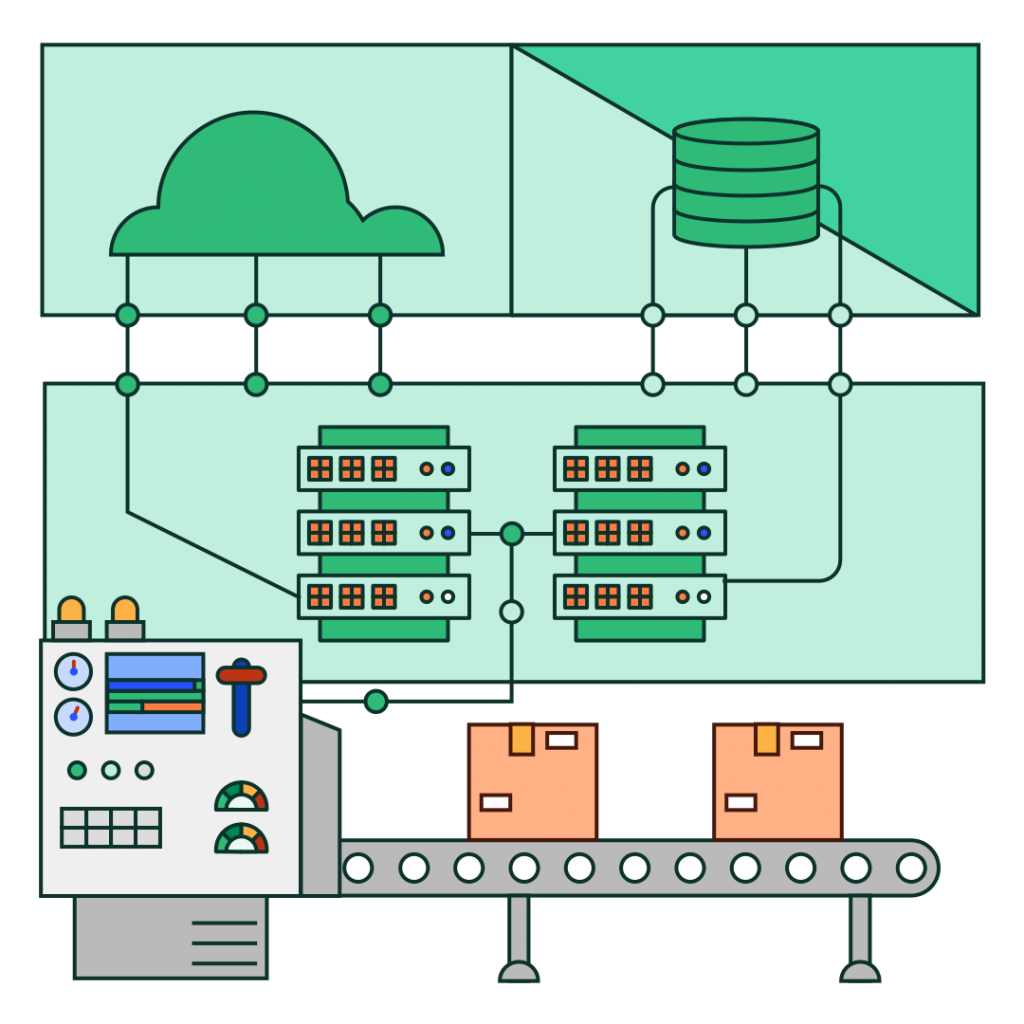
AI promises unprecedented insights, automation and business value. But as organizations move from experimentation to production, we’re hearing more about a fundamental architectural challenge: data gravity.
Data gravity refers to the tendency of large datasets to attract applications, services and infrastructure toward them. As data volumes grow, moving that data becomes increasingly expensive, slow and operationally complex.
In the world of AI, this creates a critical question:
Should we move massive datasets to centralized cloud AI platforms — or move AI workloads closer to where the data already exists?
Data gravity is the tendency for large datasets to attract applications and services, making data movement increasingly expensive and complex, especially in the context of AI.
Minimize hidden costs such as network egress fees and infrastructure spend by moving AI workloads to the data rather than transporting massive datasets to centralized cloud platforms.
Solve latency issues by processing data at the edge or in local data centers to ensure millisecond-level response times.
Ensure regulatory compliance with data sovereignty and privacy laws by utilizing hybrid AI architectures that keep sensitive information within specific geographic or corporate boundaries.
Adopt cloud native infrastructure like Kubernetes and containers to enable a “build once, deploy anywhere” model, allowing for consistent AI inference across distributed environments.
Understanding the data gravity problem
AI systems depend on vast quantities of data:
Training datasets
Real-time event streams
Sensor and IoT data
Transaction logs
Video, images and audio
As data grows into terabytes and petabytes, it becomes increasingly difficult to move efficiently.
Moving large datasets to centralized cloud environments introduces:
High network egress costs
Increased infrastructure spend
Complex data pipelines
Long ingestion delays
Operational fragility
Even modest latency can severely degrade AI performance, especially for real-time use cases like fraud detection, predictive maintenance, personalization and autonomous systems.
Why cloud-only AI architectures break down
Public cloud platforms offer unmatched scale and elasticity, making them attractive for AI workloads. However, cloud-only AI strategies often struggle when data is geographically-distributed or generated at the edge.
1. Latency constraints
Real-time AI systems often require millisecond-level response times. Routing data across regions — or continents — introduces delays that simply cannot be tolerated.
Examples include:
In these scenarios, data must be processed close to where it is generated.
2. Escalating costs
Data transfer costs scale linearly with volume — but AI workloads often grow exponentially.
Common cost drivers include:
Continuous data ingestion
Multi-region replication
Long-term storage
Repeated training pipelines
For many organizations, data movement becomes the largest cost driver in AI programs, often exceeding compute and storage costs.
3. Regulatory and compliance challenges
Many industries face strict rules around:
Centralizing sensitive data in public clouds may violate compliance requirements, forcing organizations to adopt localized or hybrid AI architectures.
As Gartner notes in the Market Guide for Hybrid AI Infrastructure, “The emphasis on supporting enterprise AI ambitions highlights the need to support AI workload on-premises, at the edge and within a public cloud hyperscaler. This need exists because some AI workloads will be deployed where the data resides due to security, compliance and performance considerations. And moving the data is often expensive.”
Moving AI to data: a better model
Instead of transporting data to the cloud or centralized AI platforms, many organizations are now bringing AI workloads closer to where the data lives.
This includes:
Edge environments
On-premises data centers
Regional cloud zones
Distributed compute clusters
Gartner predicts that “By 2028, more than 20% of enterprises will run AI workloads (training and/or inference) locally in their data centers, an increase from fewer than 2% as of early 2025.”
Benefits of moving AI to data
Lower latency: Faster inference and real-time processing
Reduced costs: Less data movement and network spend
Improved resilience: Local processing during connectivity failures
Regulatory compliance: Data stays within required boundaries
Scalability: Distributed compute aligns with distributed data
The rise of distributed and hybrid AI architectures
To address data gravity, organizations are increasingly adopting hybrid and distributed AI platforms built on cloud native technologies. These AI platforms offer the freedom and flexibility to deploy AI workloads wherever they’re needed: on-premises, at the edge, or in the cloud.
Key Architectural Patterns
Edge inference, centralized training: Models trained centrally, deployed close to data sources.
Federated learning: Training happens locally, only model updates move across networks.
Hybrid cloud AI: Training and inference distributed across on-premises, edge and cloud.
Multi-region AI platforms: AI workloads deployed geographically alongside data sources.
Cloud native infrastructure makes this possible
Containers and Kubernetes now allow AI workloads to run consistently across public and private clouds, on-premises, and edge environments.
This enables a “build once, deploy anywhere” model for AI, breaking the traditional constraint of centralized compute.
Strategic implications for AI leaders
Organizations that ignore data gravity risk:
Unpredictable cloud bills
High-latency AI systems
Poor user experience
Regulatory roadblocks
Those that embrace distributed AI architectures gain:
Faster time to insight
Lower operational costs
Better real-time performance
Greater architectural flexibility
Plan for hybrid AI to address data gravity
The future of AI is not purely centralized.
As data volumes grow and real-time demands increase, moving AI to data — not data to AI — becomes the smarter strategy.
The organizations that win in AI will be those that design architectures around data gravity, not against it.
To learn more about deploying AI workloads closer to data, read Gartner’s Market Guide for Hybrid AI Infrastructure.